Start with what you carry, not what you might carry
Before comparing styles, empty your current wallet and sort its contents into three groups: items you use regularly, items you need occasionally and items that belong elsewhere. Set aside old receipts and duplicate cards. The remaining essentials give you a more useful starting point than the number of slots advertised on a product page.
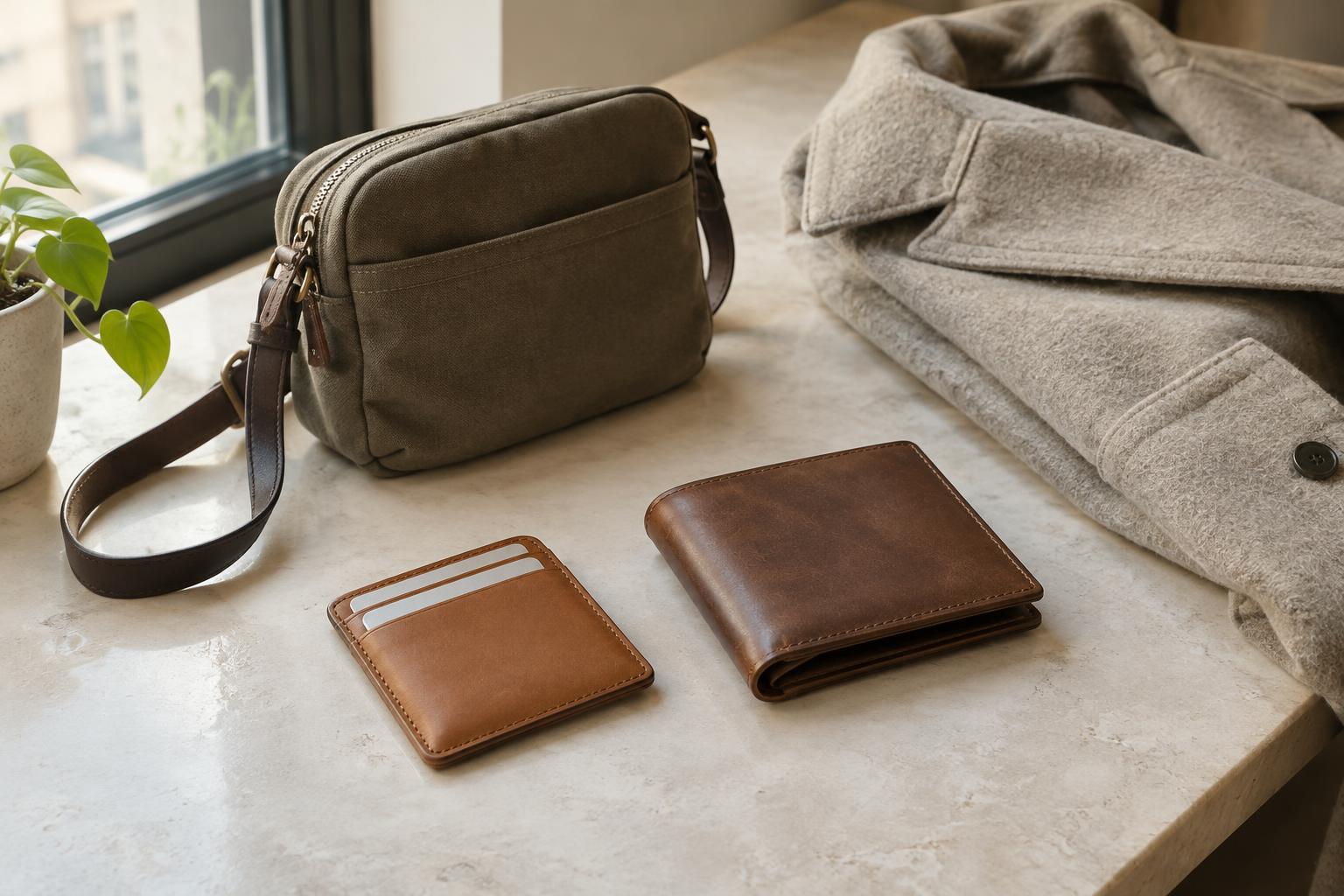
If you mainly carry a few cards, a cardholder may be enough. If you regularly use cash, coins, tickets or several forms of identification, a compact wallet with separate compartments may be easier to manage. Leave a little room for temporary items, but avoid choosing a large wallet solely for things you rarely take with you.
Match the shape to your bag or pocket
Think about where the wallet will spend most of its time. A slim cardholder can fit into a trouser or jacket pocket without adding much bulk. A folded wallet may suit a medium-sized bag, while a long wallet generally needs a larger compartment. Check both the wallet’s dimensions and the opening it must pass through: an item can fit inside a bag yet still be awkward to put away.
If you switch between bags, test the smallest one you use often. A wallet that fits that bag can usually move into a larger one, though a tiny cardholder may be harder to find in a roomy tote. In that case, choose a consistent inner pocket or a small pouch so you are not searching the bottom of the bag each time you pay.
Look closely at how it opens and closes
A useful layout lets you reach your most-used card without pulling out everything else. Look for slots that hold cards securely but do not require a struggle to release them. If you carry cash, check whether notes fit the way you prefer to store them. For coins, consider whether you would rather have a small zipped section or keep change in a separate pouch.
Try to picture the whole sequence of use: take it out, open it, find what you need, put the item back and close it. A clasp, zip or snap can help keep contents contained, but it should be comfortable to operate. If you often handle your wallet while carrying other things, a simple closure may feel less fiddly than several overlapping compartments.
Choose a finish you can live with
Material and color affect how a wallet fits into your routine. Smooth finishes are easy to slip into a pocket, while textured surfaces may feel easier to grip. A dark or patterned finish can make everyday marks less noticeable; a bright color can help you spot a wallet inside a bag. The best choice is not necessarily the most decorative one, but the one you will enjoy using and can care for realistically.
Look at construction as well as appearance. Check the stitching around card slots, the edges of frequently handled areas and whether a closure lines up neatly. Whatever the material, avoid overstuffing it: stretched slots and strained closures can make even a well-chosen wallet less convenient over time. Follow any care directions supplied with the item rather than assuming one cleaning method suits every finish.
Make the final choice with a quick trial
If possible, place your usual cards and other essentials inside before deciding. Close the wallet, hold it as you would when paying and check how it sits in your usual bag or pocket. If you cannot try it in person, compare its listed dimensions with an object you already carry comfortably.
A wallet or cardholder is a small accessory, but you may reach for it many times in a day. Choose the format that makes those moments straightforward. You can keep a larger wallet for days when you need extra documents or cash and use a smaller cardholder for lighter outings, without expecting one style to handle every situation.