Start with the neckline, not the knot
The most useful scarf tie is one that works with the shape of your clothes. Before tying anything, notice where the neckline ends and how much space there is between your face and the top of your outfit. A close neckline leaves little room for bulky folds; an open neckline can accommodate a scarf that fills some of the space. The goal is not a perfectly symmetrical knot. It is a shape that stays comfortable and looks intentional as you move.
Fabric matters as much as length. A light silk or cotton square folds neatly into a narrow band, while a soft rectangular scarf creates looser loops and longer ends. For everyday wear, tie the scarf while looking in a mirror, then turn your head and sit down. If it pulls against your neck or shifts over the neckline, loosen it or try fewer wraps.
Crew necks: add a small shape above the collar
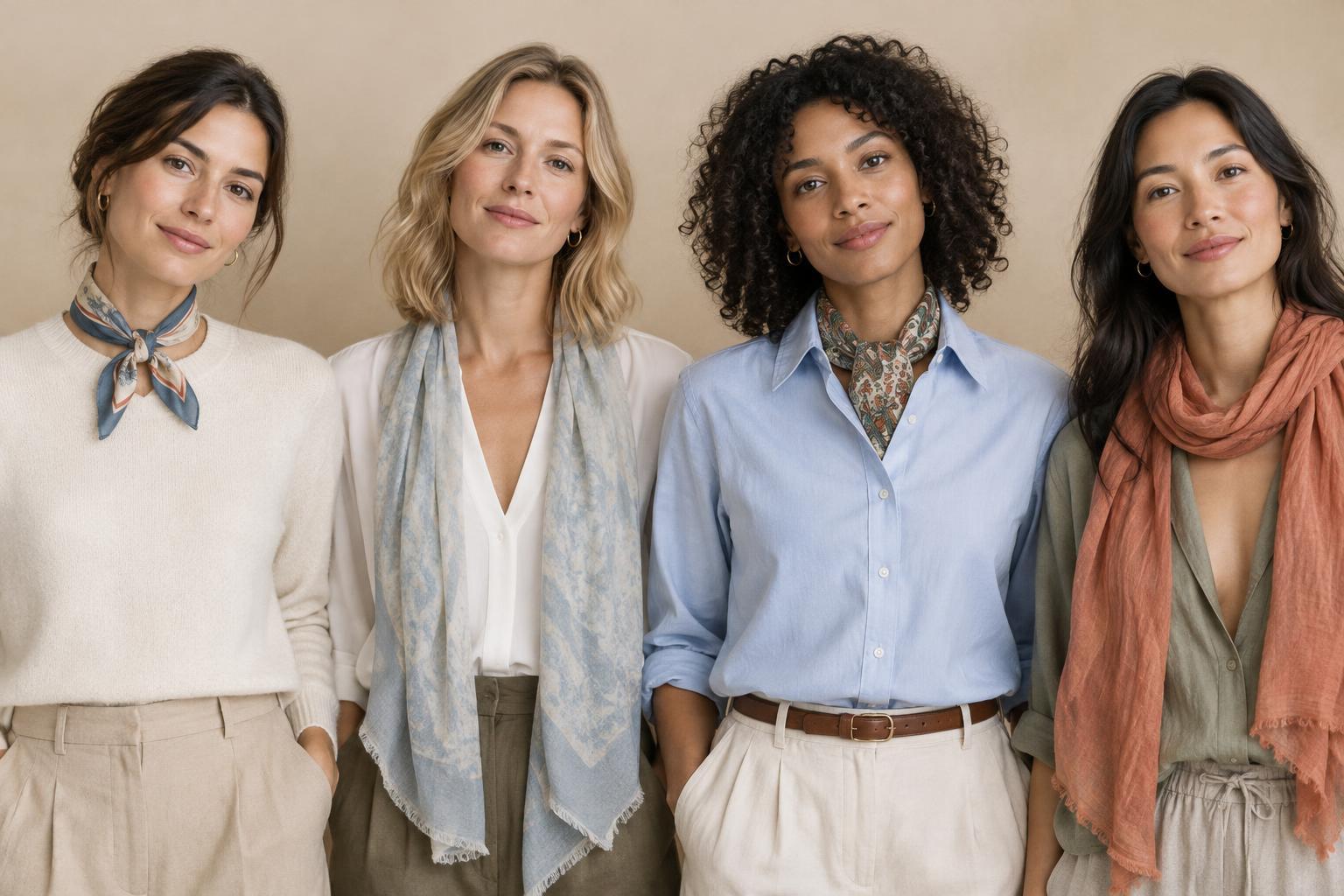
A crew-neck T-shirt or sweater already draws a clear line around the base of the neck. A small neckerchief can sit just above that line without covering it. Fold a square scarf diagonally, then roll it from the point toward the long edge until it forms a band. Wrap it once around your neck and tie a simple double knot at the side. Keep the knot small and leave the tips short enough that they do not compete with the collar.
If you want a softer look, use a thin rectangular scarf in a loose single loop instead. Place it around the back of your neck with one end slightly longer, bring the longer end around once and let both ends hang at the front. Pull the loop away from your throat and spread the fabric slightly. This works especially well over a plain crew neck because the scarf adds texture without needing an elaborate tie.
V-necks: follow the opening
A V-neck creates a downward line, so a scarf often looks balanced when its ends follow that direction. For a simple drape, fold a light square into a triangle and place the point at the front, with the other two ends around your neck. Tie those ends loosely behind your neck, then adjust the point so it rests inside the V or just above it. The triangle fills the opening while leaving the shape of the neckline visible.
For a narrower V, try a long scarf with a single, low knot. Drape it around your neck, tie the ends once near the top of the V and let them hang down the center. Avoid tightening the knot against your throat; a little space keeps the arrangement relaxed. If the scarf is patterned and the top is solid, the hanging ends can provide the main detail of the outfit.
Shirt collars: choose inside or outside
A collared shirt gives you two straightforward options. To wear a scarf inside the collar, open the top button or two, fold a small square into a band and tie it loosely at the front. Tuck the ends beneath the shirt opening if you prefer a tidy finish, or leave them visible for a casual accent. A thin fabric is easiest here because it will not crowd the collar.
To wear a scarf outside, let the shirt collar remain the main feature. Place a medium-length rectangular scarf around the back of your neck and bring both ends forward without tying them. You can tuck the ends under a jacket or cardigan so they stay in place. If you need a more secure option, tie a loose knot below the collar points rather than directly over them. This keeps the collar from folding awkwardly.
Open and high necklines: adjust the volume
A boat neck or square neck leaves space across the collarbones. A scarf can echo that width: drape a lightweight rectangular scarf over your shoulders and let the ends fall in front, or tie a small square off to one side. Keep the center of the neckline visible if you want to preserve its shape. With a scoop neck, a loose loop can sit within the curve; shorten or lengthen it until the bottom of the loop does not stop at an awkward point on the neckline.
A turtleneck calls for the opposite approach because the neck is already covered. Rather than adding a tight knot, use a longer scarf in one relaxed loop over the top, with the ends hanging down. You can also skip the neck entirely and tie a small scarf to a bag handle for color. No single tie suits every fabric or outfit: if a scarf bunches, twists or needs constant readjustment, simplify the fold or choose a lighter one.