Start with what is visible
Before choosing a pair, put on the top or jacket you plan to wear and arrange your hair as you normally would. Look at the space around your face. Are your ears exposed, partly covered, or hidden? Does the collar sit close to your jaw, or does it leave an open neckline? These details often matter more than a rule about face shape. An earring needs enough visible space to be noticed without competing with everything around it.
Think of earrings, hair, and collar as three shapes sharing a small area. If two are already prominent, let the third be simpler. A high collar and a full hairstyle, for example, may look balanced with small hoops or neat studs. With a plain open-neck top and hair pulled back, you have more room for a longer or more sculptural pair. This is a starting point, not a restriction: the best choice is also one you enjoy wearing.
Work with your hairstyle
Short hair, a sleek bun, or a ponytail leaves earrings in clear view. Studs can look deliberate in that setting, especially when their color or finish contrasts gently with your hair. If you want a stronger accent, try a medium hoop, a broad drop, or a distinctive shape. Check the pair from the front and side: an earring that looks small on a tray can have plenty of presence when there is no hair around it.
With loose hair, consider whether it covers the earlobes or moves across them during the day. A tiny stud may disappear beneath thick hair, while a shiny hoop or a drop that extends just below the hairline may remain visible. Textured or brightly colored earrings can stand out without being especially long. If your hair catches easily on jewelry, choose smooth edges and secure backs, and test the pair while turning your head before leaving home.
Let the collar set the scale
A crewneck or other close, simple neckline gives you flexibility because it does not add much detail near the earrings. You might use a small pair for a quiet outfit or longer earrings to draw attention upward. A turtleneck fills more of that space. Compact earrings can keep the look clean, while a bold pair can provide a clear focal point. If the collar is thick, check that dangling earrings do not brush against it every time you move.
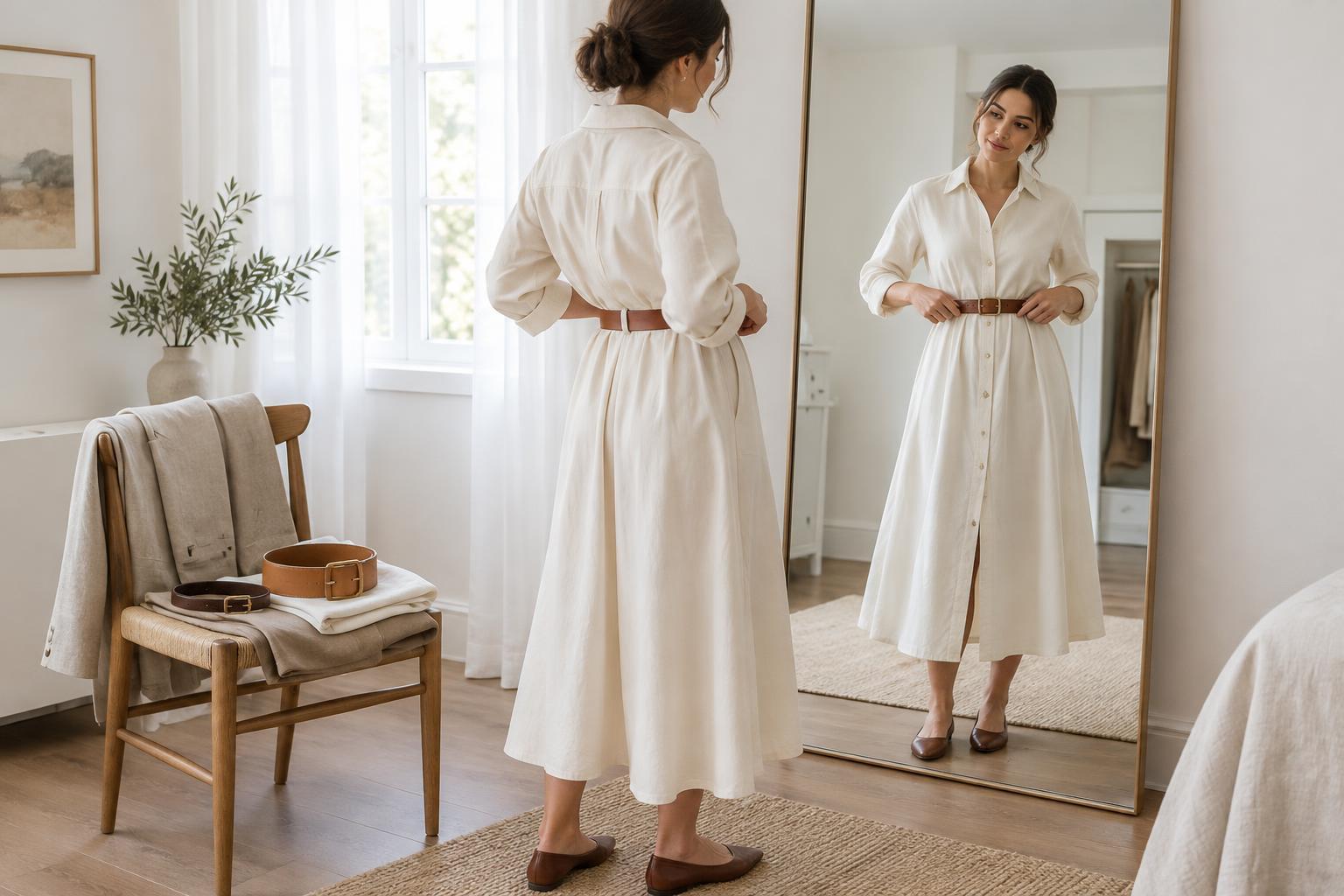
Button-down shirts, pointed collars, and jackets introduce lines and corners near the face. Rounded hoops can soften those angles; straight drops can echo them. Neither approach is inherently better. For a shirt worn open at the neck, a drop can occupy some of the open space without requiring a necklace. With a ruffled, embellished, or wide collar, simpler earrings often prevent the details from crowding one another. Try the full outfit on rather than judging the earrings alone.
Choose a relationship, not a perfect match
Earrings do not have to match your clothing exactly. Repeating one element is often enough to make an outfit feel connected. A warm-toned metal can pick up the warmth of a cream blouse; a dark stone can relate to a dark jacket. You can also create contrast: pale earrings may stand out against dark hair, while a saturated color can enliven a neutral top. Look for a combination that reads clearly at a comfortable distance.
Consider other accessories in the same area. If you are wearing glasses, a scarf, or a necklace, decide which item you want to notice first. An intricate scarf and statement earrings can both work, but they may need a common color or a quieter shape to feel cohesive. For an easy everyday formula, choose one focal accessory near your face and let the others support it. That approach still leaves room to mix metals, colors, and textures.
Make a final comfort check
An earring is only versatile if you can wear it through the activities you have planned. Check its weight, fastening, and movement. Long drops may suit an evening outfit but get in the way when you put on a coat or carry a shoulder bag. Hoops can catch on loose strands or a scarf. If your day involves frequent changes of clothing, a close-fitting pair may be the easier choice.
A small working collection can cover many outfits: one understated pair, one medium-size option with visible shape, and one pair that feels expressive to you. Try each with your most-worn hairstyles and collars. You may discover that the pair you thought was reserved for special occasions works with a simple shirt, or that your favorite studs look best when your hair is tucked back. Those observations are more useful than a fixed list of rules.