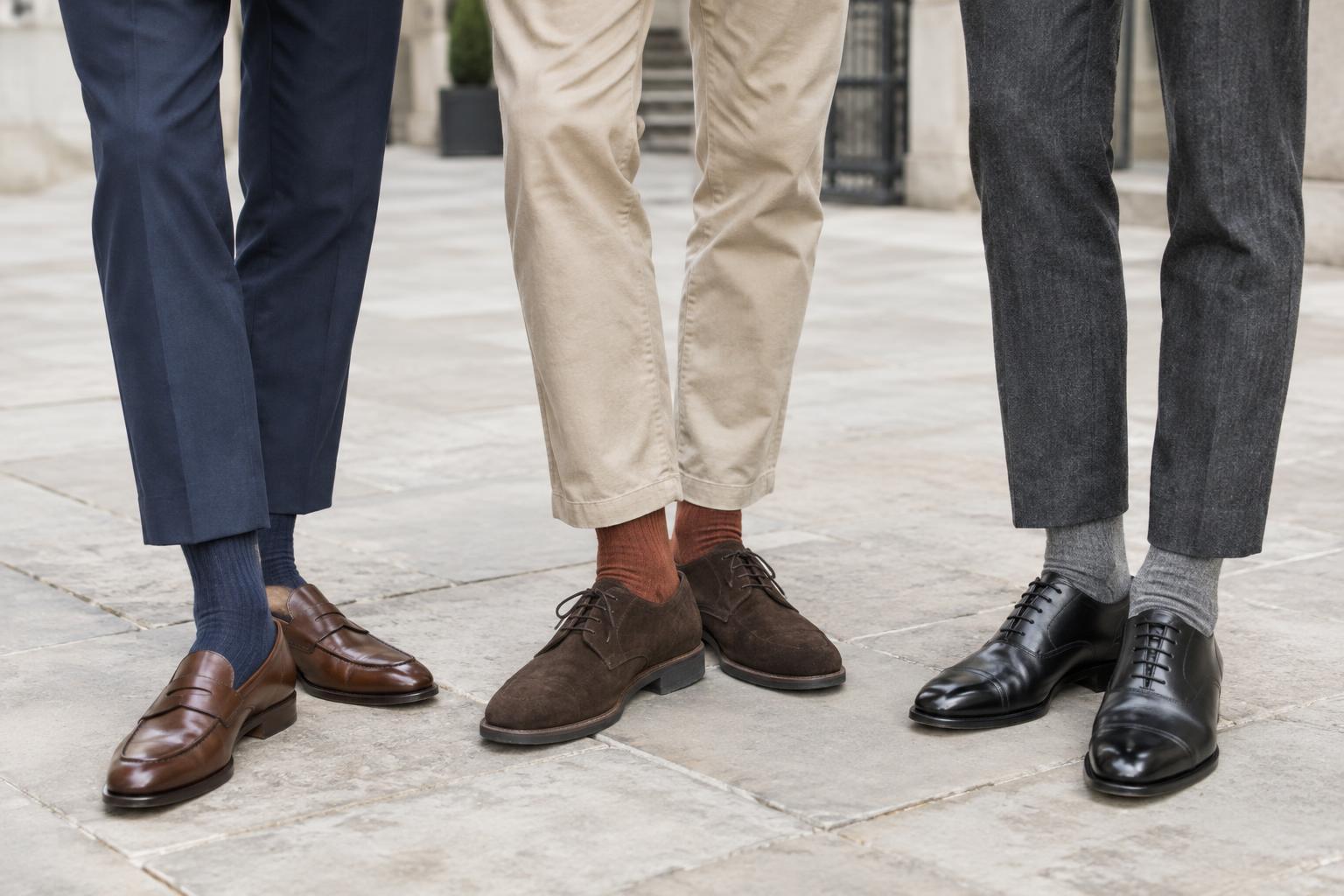
Start with the amount of sock on show
Before choosing a color, look at where your trouser hem falls when you stand, walk and sit. A full-length trouser may reveal only a narrow band of sock in motion; a cropped trouser can leave several inches visible throughout the day. The larger that visible area, the more the socks contribute to the outfit’s overall color and texture. Treat a wide gap almost as you would another garment, rather than as a small detail.
Sock height matters too. If you want a continuous line between trousers and shoes, choose a pair tall enough to cover your leg when seated. If a glimpse of skin is intentional, make sure the trouser length and shoe style support that lighter, more casual effect. Testing the whole outfit while seated is a simple way to spot a gap you did not expect.
Choose what the socks should connect
The easiest approach is to relate the socks to the trousers. Navy socks with navy trousers, for example, keep the leg line visually uninterrupted even when brown shoes sit below it. The colors need not be identical: charcoal socks can work with mid-gray trousers, and a slightly deeper shade often gives the outfit quiet definition. This is a useful starting point when the shoes already attract attention.
Alternatively, socks can echo the shoes or another part of the outfit. Dark brown socks above brown loafers make the transition to the shoe feel soft, while a muted burgundy pair can pick up a small accent in a shirt or scarf. Avoid trying to match every item exactly. Repeating a color family, or a similarly warm or cool tone, usually feels more natural than assembling several nearly identical shades.
Use contrast with a purpose
Contrasting socks can brighten a restrained outfit. With charcoal trousers and black shoes, a deep green or burgundy sock adds color without taking over. With stone trousers and tan shoes, a darker olive sock introduces enough contrast to be visible while staying within an earthy palette. If the trousers, socks and shoes are all high-contrast colors, each transition becomes more prominent; that can be playful, but it is less subtle.
A helpful way to judge a bold sock is to step back and look at the full outfit. If the socks are the only vivid element, decide whether you want them to be the focal point. If not, choose a muted version of the color or repeat it somewhere small, such as in a patterned shirt. For patterned socks, a simple stripe or small motif is often easier to coordinate than a print containing several competing colors.
Match texture to the clothes and shoes
Color is only part of the decision. A fine, smooth sock sits comfortably alongside pressed wool trousers and polished leather shoes. Ribbed cotton can give chinos and casual leather shoes a little texture without looking bulky. Heavier knits suit relaxed trousers and substantial footwear, but they may crowd a close-fitting shoe or make a sharply tailored outfit feel uneven.
You do not have to duplicate the fabric of your trousers. Instead, aim for a similar level of formality and visual weight. A textured sock can bring interest to plain trousers, while a smoother pair can calm an outfit that already includes corduroy, suede or a patterned shoe. Also consider comfort: a sock that slips, bunches or stretches too tightly will distract from even a well-planned combination.
Build a small set of reliable combinations
For everyday wear, begin with a few socks that work across several outfits: a dark neutral close to your most-worn trousers, a softer midtone, and one muted accent color you enjoy. Try each pair with your usual shoes rather than judging it in isolation. Dark socks with dark trousers provide a dependable baseline; from there, changing just one element makes it easier to see what a lighter or more colorful pair contributes.
Visible socks do not need to make a statement every time. Sometimes their job is to bridge the space between a hem and a shoe; sometimes they offer a small surprise. Check the proportions, choose one clear color relationship, and let the fabric suit the rest of the outfit. Those three decisions make socks feel considered without making getting dressed complicated.