Check the places on your route first
A full sightseeing day rarely has one dress code. You might spend the morning walking outdoors, visit a place of worship after lunch and end the day at a restaurant. Rather than packing a separate outfit for every stop, look at your planned venues before you get dressed. Check their own visitor guidance for clothing, bags and footwear, especially where entry may depend on what you wear.
Do not assume that one rule applies to every museum, historic building or sacred space. Some venues may ask visitors to cover shoulders or knees; others may have different expectations or none at all. If the guidance is unclear, choose an outfit with more coverage and carry a layer you can put on easily. A quick check can also save you from bringing a bag that must be stored or shoes that are unsuitable for part of your route.
Start with a comfortable, adaptable base
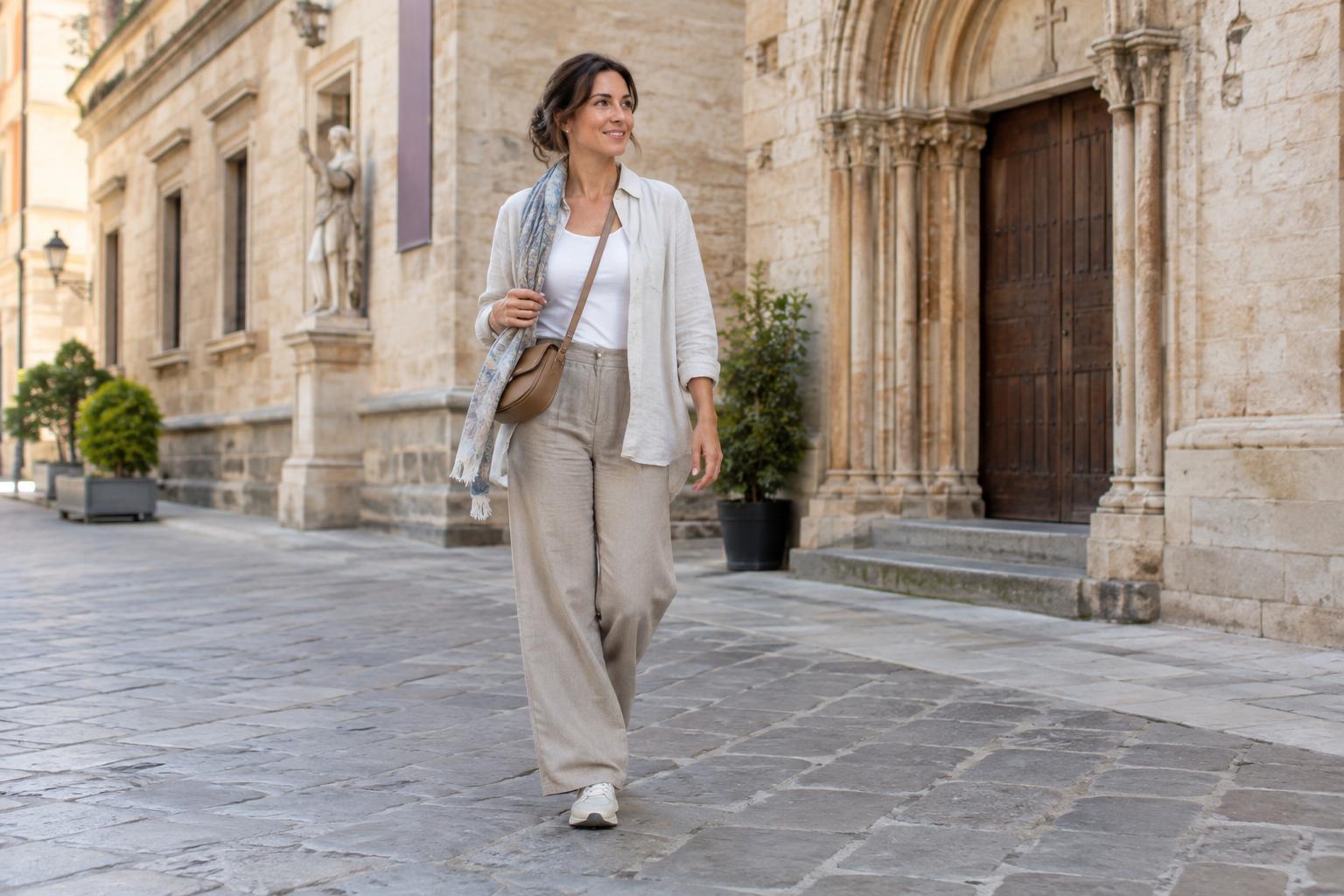
For a day with varied stops, begin with clothes you can walk and sit in comfortably. Straight-leg trousers, a relaxed skirt or a simple dress can form a useful base, depending on the weather and your preferences. Pair them with a top that stays comfortable under an extra layer. If you expect to move between warm streets and cool interiors, breathable fabrics and pieces that are easy to remove may feel better than one heavy garment.
Pay attention to how the outfit behaves in motion. A hem that needs constant adjusting or a waistband that feels restrictive after an hour can distract from the day. Darker or patterned pieces can be forgiving of small marks picked up while travelling, but comfort matters more than any particular color. Choose a base you would be happy wearing for most of the route, then use layers for the stops that call for something different.
Use layers to change coverage quickly
An overshirt, lightweight cardigan or loose button-up can make a sleeveless base more adaptable without requiring a full change. A scarf may offer another option for warmth or coverage, but it should not be treated as a guaranteed substitute for a venue’s stated requirements. If you know a stop has specific rules, bring clothing that clearly meets them.
Make the extra piece easy to reach. A layer buried at the bottom of a tightly packed bag is less useful when you arrive at an entrance. Put it on before joining a queue so you are not trying to rearrange your outfit at the door. When the visit is over, you can remove it for the walk to your next stop. This approach works particularly well when the temperature changes as often as the setting does.
Choose shoes and a bag for the whole day
Sightseeing shoes need to work beyond the first photo stop. Consider how far you expect to walk, whether you will encounter steps or uneven surfaces, and how long you may stand. Shoes you have already worn comfortably are usually a safer choice than a new pair saved for the trip. If a venue has footwear rules, follow its guidance rather than assuming your everyday walking shoes will be suitable.
A small bag can hold your layer, water and essentials while leaving your hands free. Before you leave, check whether any planned venue limits bag size or requires bags to be stored. Pack only what you are willing to carry for hours, and keep tickets or other frequently needed items accessible. A compact, well-organized bag makes transitions between stops simpler than one you have to unpack at every entrance.
Build one outfit, then test it against the itinerary
Imagine a day that includes a long outdoor walk, a sacred space and an informal dinner. You could wear comfortable trousers, a short-sleeved top and familiar walking shoes, with a lightweight long-sleeved shirt in your bag. Before leaving, check whether the shirt and trousers meet the sacred space’s particular guidance. The same shirt can serve as a layer in a cool interior and make the outfit feel a little more put together at dinner.
Once you have chosen your clothes, run through the day in order: Can you walk comfortably? Do you have the coverage each venue requests? Can you carry what you need without overloading yourself? Is there a sensible option if the weather changes? A sightseeing outfit does not need to look identical at every stop. It needs to let you move between them with comfort and respect for each place.