Understand what you are removing
Fabric pills are small balls of fiber that form on the surface of clothing. Loose fibers work their way outward and tangle as the fabric rubs against itself, another garment, a bag strap, or a seat. They often show up under the arms, along the sides of a sweater, or between the thighs of trousers. Pilling does not necessarily mean a garment is poorly made; even a well-loved knit can pill where it gets frequent friction.
The aim is to remove the raised balls, not the fabric beneath them. Before you start, check the care label and look closely at the surface. A dense sweatshirt can usually tolerate a different approach from a loose, fluffy knit. If the fabric is already thin, snagged, or unusually textured, work especially slowly. When in doubt, test your tool on a small, less visible area first.
Prepare the garment and choose a tool
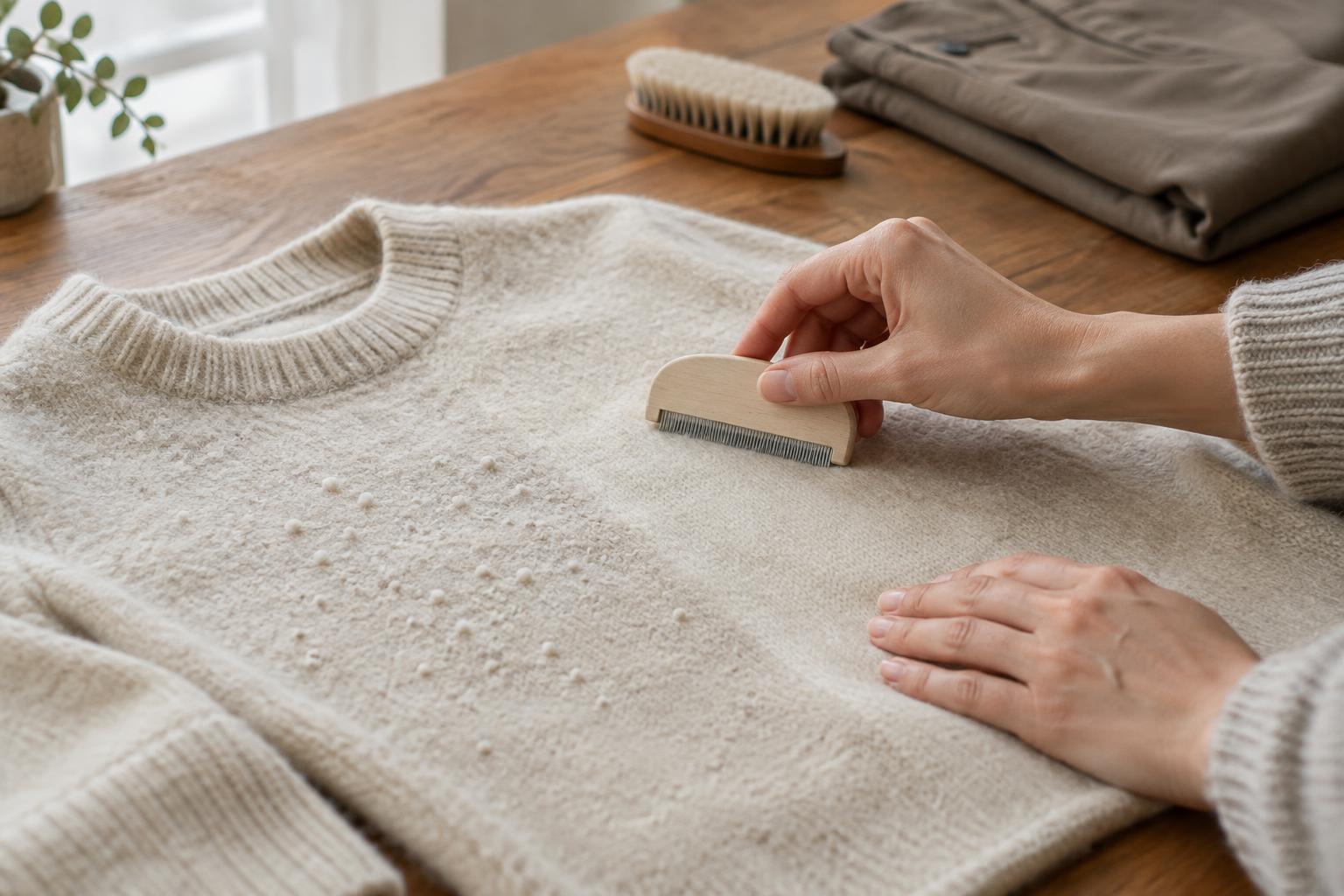
Begin with a clean, completely dry garment. Lay it flat on a firm surface and smooth out folds without stretching the fabric. Good lighting helps you see which areas need attention and whether a tool is catching threads. Keep one hand nearby to hold the fabric steady, rather than pulling it taut enough to distort the shape.
A battery-powered fabric shaver is convenient for relatively smooth, stable surfaces. Its guarded blades trim pills that enter the cutting head. A sweater comb or fabric comb gives you more control on some knits, especially when you want to treat a small area. Neither tool is suitable for every garment: raised embroidery, openwork stitches, loose loops, and decorative threads can catch. A household razor has no protective guard and is easy to press too deeply, so it is a riskier choice, particularly for fine fabrics.
Remove pills with a light touch
If you use a fabric shaver, start on its gentlest suitable setting, if it has one. Rest the head lightly against a small test area and move it in slow, short passes. Do not press down to reach every pill at once. Pause often to brush away loose fibers and check the cloth underneath. Empty the shaver’s collection chamber as needed so the tool continues to move smoothly.
With a comb, follow the direction of the knit or weave using short, gentle strokes. Lift away the collected pills with your fingers rather than repeatedly scraping the same spot. For a handful of larger pills on a delicate item, you may be better off carefully snipping each one with small scissors while the garment lies flat. Cut only the ball of fiber above the surface, and stop if you cannot clearly separate it from a thread in the garment.
Treat the most noticeable areas first, then step back and assess the result. A few remaining pills are less distracting than a shaved patch or a pulled stitch. If the fabric begins to look fuzzy or thin, stop. Removing pills improves the surface appearance, but it cannot restore fibers that have already worn away.
Adjust your approach to the fabric
On a sturdy, tightly knit cotton sweater, a light pass with a guarded shaver may be straightforward. On a soft wool or cashmere knit, try a small test area and use minimal pressure; a comb designed for knits may offer better control. For loosely knit, brushed, or very fine garments, individual removal can be safer than sweeping a tool across the whole surface. Avoid running a shaver over seams, buttons, zippers, or areas with raised details.
Texture also matters more than the fiber name alone. Two wool sweaters may respond differently if one has a compact surface and the other has long, airy fibers. If a pill is attached to a long loop, do not tug it free. Pulling can tighten or distort a stitch, leaving a more visible flaw than the pill itself.
Help prevent pills from returning
You cannot eliminate friction from everyday wear, but you can reduce some of it. Give knits a rest between wears, and consider where rough bag straps or jacket linings repeatedly rub. When washing is appropriate, turn garments inside out, use the care-label settings, and avoid crowding the machine. A laundry bag can help separate delicate pieces from zippers and other abrasive items. Dry garments as directed on their labels, since excessive agitation can add wear.
Make depilling an occasional, gentle part of garment care rather than an aggressive attempt to make fabric look new after every wear. A quick inspection before putting a sweater away lets you address a small patch before it becomes more noticeable. With the right tool and a patient approach, you can tidy the surface while preserving the shape and texture that made the piece worth keeping.


