Why the first touch can mislead
Softness is inviting, but it tells you only one thing about a fabric: how its surface feels against your hand at that moment. It does not tell you whether a skirt will hold its shape, a shirt will cling, or trousers will become revealing when you bend. A fabric that feels smooth on a small swatch may also behave differently across an entire garment.
Start with the job the fabric needs to do. For a crisp overshirt, you might want enough structure to keep the collar and pockets defined. For a relaxed blouse, you might prefer fluid movement. Neither choice is better in general; the mistake is choosing by touch without considering the intended silhouette. If you are shopping for yardage, bring a pattern or a clear idea of the garment. If you are shopping for ready-to-wear, picture where and how you will wear it.
Check drape before you imagine the finished outfit
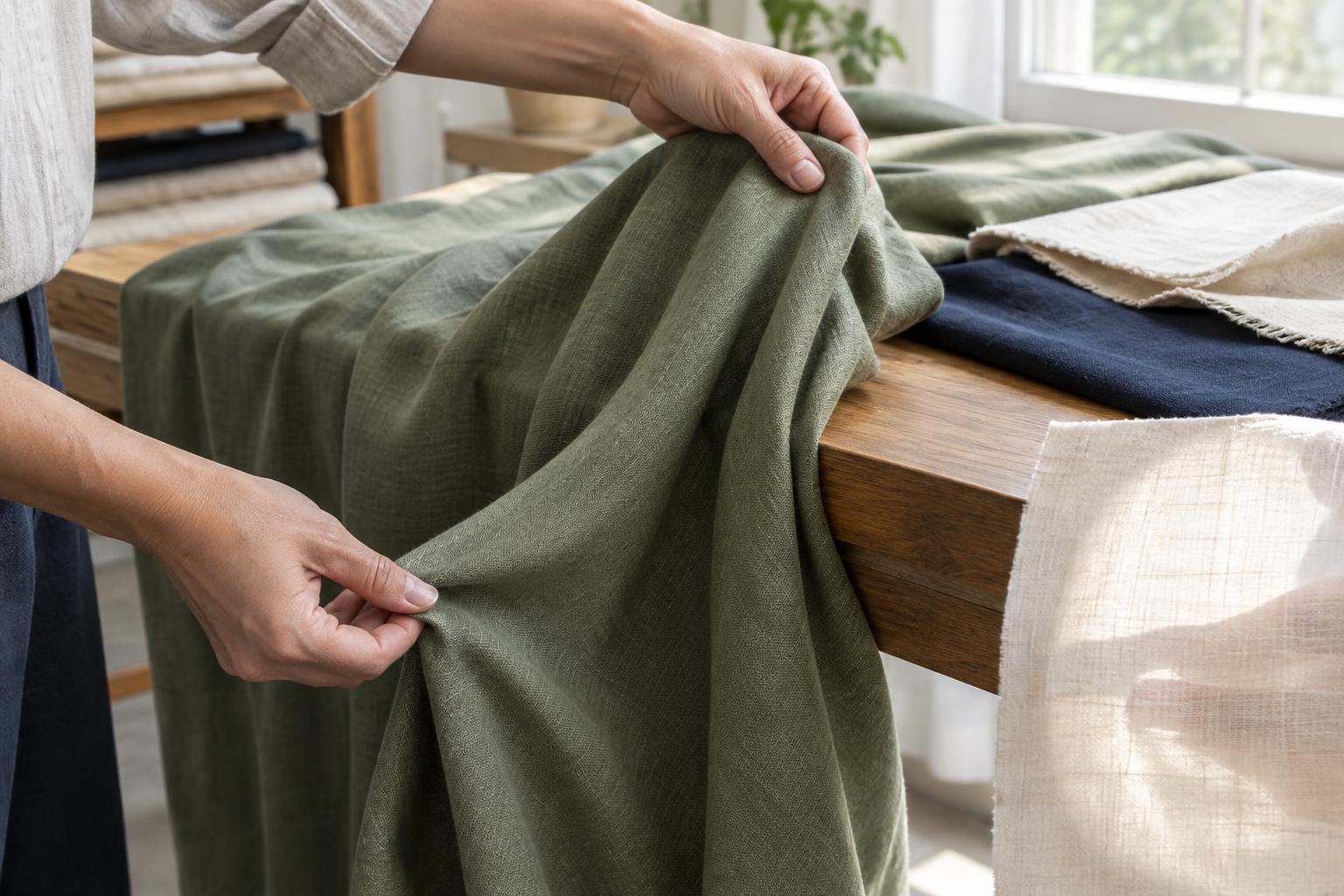
Drape describes how fabric falls under its own weight. To assess it, let a generous length hang from your hand rather than judging a tightly folded stack. Look at the folds: do they fall in soft, narrow lines, or stand away from the body in broader shapes? Then move the fabric gently. A material can feel soft yet be firm enough to create volume, while another may feel less plush but fall close to the body.
Compare what you see with the garment’s design. A gathered skirt made from a structured fabric may look full at the waist; the same shape in a fluid fabric may fall in narrower folds. A loose shirt in a very fluid material might trace the body more than you expect. Neither result is necessarily a problem, but it helps to decide before you buy.
With a finished garment, try it on and look at it from the side as well as the front. Sit, walk and raise your arms. Notice whether hems hang evenly, seams pull, or the fabric catches on the layers underneath. If you cannot try it on, check several views of the garment and allow for uncertainty: a product image cannot show every movement.
Test stretch and recovery, not just give
Stretch can make a garment comfortable, but the useful question is whether the fabric stretches in the direction you need and returns to shape. Gently pull a small section across its width and then its length. Some woven fabrics give a little on the diagonal without being suitable for a close-fitting design. Knits may stretch readily in one direction and much less in the other.
After a gentle pull, release the fabric and see whether it settles back. If it stays wavy or grows visibly, a fitted neckline, knee or elbow may be harder to keep neat with wear. This quick check is not a promise about long-term performance, but it can reveal an immediate mismatch between fabric and design. Avoid tugging hard on merchandise that is not yours.
Think about ease as well. Stretch does not automatically make a too-small garment fit well; strain lines and distorted seams are signs to reconsider the size or cut. Conversely, a fabric without much stretch can be comfortable when the garment has enough room to move. Check the fabric and the shape together rather than relying on a label such as “stretch” or “relaxed.”
Look for opacity in the conditions you will actually wear it
Opacity can change with light, color, lining and tension. Hold a single layer of fabric up to a light source, then place it against your hand or a contrasting layer to see what shows through. For a finished garment, check it in good light while standing and moving. Pay particular attention to areas pulled taut when you sit or bend, since a fabric may appear opaque when loose but reveal more when stretched.
A light-colored top that looks substantial on a hanger may need a camisole in daylight; a pale skirt may work better with a lining. Those can be useful styling choices if you are happy to make them. The buying mistake is discovering the requirement only after you have planned an outfit around wearing the piece on its own.
Before deciding, make a brief mental checklist: Does it hang the way the design needs? Does it give and recover where movement matters? Does it provide the coverage you want in likely lighting? Softness still belongs on that list, especially for pieces worn close to the skin. It simply works best as one consideration among several, not the deciding test.